Governance structure
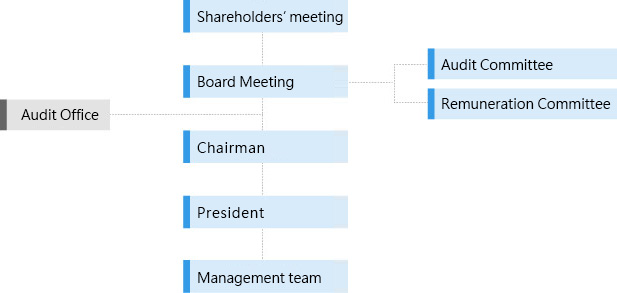
The Role of the Board of Directors
- Guide company strategy
- Supervise the managers
- Responsible to the company and shareholders
The Role of the Audit Committee
- Supervise the proper expression of the company's financial statements
- Supervise the selection/dismissal of independent auditors and their independence and performance
- Supervise the effective implementation of the company's internal control
- Supervise the company's compliance with relevant laws and regulations
- Supervise the management and control of the company's existing or potential risks
The Role of the Compensation Committee
- Evaluate the compensation policies and systems of directors and managers
- Evaluate the achievement of performance goals of directors and managers
Committee members
| Name | Audit Committee | Compensation Committee |
|---|---|---|
| Independent director Fang-Tsai Chiu |
V (Chairman) | V |
| Independent director Tsung-Min Chen |
V | V |
| Independent director Yu-Chi Huang |
V | V(Chairman) |
| Independent director Xiao-Ping Hong |
V | V |
The audit committee convenes at least once a quarter and may convene meetings as needed; the compensation committee convenes two regular meetings a year.
Please refer to the company’s annual reports for the holding condition and attendance rates of each committee meeting.
Member of the board
Diversity of Board Members
GeneFerm upholds the board of directors' diversity. One of the concepts is the directors who are also managers of the company cannot exceed one-third of the number of directors. Appropriate diversification policies should be formulated according to the company's operation and development, including but not limited to the following two general standards:
- 1. Basic conditions and values: gender, age, nationality, and culture, etc.
- 2. Professional knowledge and skills: background, skills and related experience, etc.
Please refer to the succession planning for members of the Board of Directors and key management.
In addition to having essential knowledge, skills and self-cultivation to perform duties, and to comply with the ideal goal of corporate governance, the board members should possess the following abilities: (1) operational judgment (2) accounting and financial analyst skills (3) operations management (4) crisis management (5) industry knowledge (6) international market philosophy (7) leadership and (8) decision-making skills and other diverse professional backgrounds.
The current board of directors of the company has 10 directors (including 4 independent directors), and the number of directors includes 2 female directors and 8 male directors.
In order to implement gender equality in the composition of the board members, the company intends to include at least one female member. Currently, independent directors represent 40% of the Board of Directors, and female directors account for 20%. While these figures complied with the regulations at the time of appointment, the ratio of either gender has not yet reached one-third. This is primarily due to the specific nature of our industry and the challenges in talent recruitment. To further implement our Board Diversity Policy, we will actively seek and nominate candidates through multiple channels to achieve a more balanced gender representation in the future. Our board members bring together diverse expertise in business and finance, significantly enhancing the Company’s operational decision-making. With independent directors encompassing the legal, accounting, and business sectors, we have successfully achieved professional diversity and ensured its rigorous execution within our governance framework.
Please refer to the resumes of the current directors and the list of the implementation of diversity in the board of directors.
Specific management goals and achievement status of the board member diversity policy:
| Management Goals | Achievement Status |
|---|---|
| The number of directors who concurrently serve as company managers should not exceed one-third of the total number of directors | Achieved |
| At least one female board member | Achieved |
Board of directors’ performance evaluation
The Company’s Board of Directors approved the "Board Performance Evaluation Measures" and its assessment methodologies on May 6, 2020. According to these measures, an external board performance evaluation shall be conducted at least once every three years by an independent professional institution or a team of external experts and scholars. In 2025, the Company commissioned the Taiwan Investor Relations Institute (TIRI) to complete the 2025 Board Performance Evaluation. For detailed information regarding the assessment methods, standards, and results, please refer to the Summary Report of the External Board Performance Evaluation.
Audit committee
The company has an audit committee composed of all independent directors. The audit committee is responsible for assisting the board of directors in performing supervisory duties and exercising securities and exchange act, corporate law and authority stipulated by other laws and regulations. The audit committee should communicate with the company's visa accountant and review the appointment, independence and performance of the certified accountant regularly. At the same time, the company's internal auditors will submit audit summary reports regularly to the audit committee based on the annual audit plan, and the audit committee will evaluate the company internal control system, internal auditors and their work periodically.
Member professional qualifications and experience
| Member | Professional qualifications and experience |
|---|---|
| Independent director Fang-Tsai Chiu |
Fang-Tsai Chiu graduated from National Cheng Kung University with an in-service master’s degree in the department of finance and are certified as professional accountant in the Republic of China (Taiwan). He is the convener of the company's audit committee and a member of the remuneration committee, incumbent director of Qing Xin accounting firm, independent director of Ying Han Technology Co., Ltd., Macauto Industrial Co., Ltd. and Spec Products Corp., with more than five years of working experience in business, finance, and accounting, assisting the company in professional accounting consulting. |
| Independent director Tsung-Min Chen |
Mr. Chen Tsung-Min holds a Master’s degree in Chemical Engineering from National Tsing Hua University. He currently serves as a member of the Audit Committee and the Remuneration Committee of the Company. He is currently the Special Assistant to the Chairman at International CSRC Investment Holdings Co., Ltd. His previous professional experience includes serving as Special Assistant in the President’s Office of USI Group, President of Chi Mei Materials Technology Corp., and Associate Vice President of the R&D and Technology Center at Linyuan Advanced Materials Technology Co., Ltd. With over five years of required business and operational experience, Mr. Chen possesses extensive industry expertise. |
| Independent director Yu-Chi Huang |
Graduated from National Taipei University with a bachelor's degree in financial and economic law. He has a professional lawyer qualification in the Republic of China. He is the convener of the company's salary and remuneration committee and a member of the audit committee. He is currently a senior lawyer at Yucheng Law Firm (Tainan) and an independent lawyer at Peibo Steel (Co., Ltd.) Directors, with more than five years of work experience required in business, legal affairs and corporate affairs, to assist in professional legal consultation for the company. |
| Independent director Hsiao-Ping Hung |
Graduated from the Accounting Department of the School of Management of National Cheng Kung University, and has the professional accountant certificate of the Republic of China. He is a member of the Audit Committee and the Salary and Remuneration Committee of the company. He is currently a practicing accountant of Ping Heng Accounting Firm and a independent director of Htcsolar Co., Ltd., with more than five years of experience Required work experience in business, finance, accounting and corporate business, and assist in corporate accounting professional consulting. |
Communication policy between independent directors, internal audit supervisors and accountants
- 1. The internal audit supervisor delivers the audit report to the independent directors every month, and the independent directors request additional information about the report and convene meetings as needed.
- 2. The internal audit supervisor shall attend the audit committee and board meetings to report on the implementation of internal audit.
- 3. Independent directors call meetings with internal audit supervisors to communicate on the company internal control operation as needed. At least once a year.
- 4. Accountants attend the Audit Committee or call meetings with independent directors to communicate on the company's financial status, overall operating situation, and relevant laws and regulations. At least once a year.
- 5. Independent directors, internal audit supervisors and accountants should call occasional meetings in case of the occurrence of abnormal events.
The 2025 communication between independent directors, internal audit and accountant
| Date | Attendees | Communicate matters | Result |
|---|---|---|---|
|
2025.11.06 |
|
|
All the independent directors have no objection |
2025 communication matters
| Meeting date (period) | Communicate matters with the internal audit supervisor | Communication matters with visa accountants |
|---|---|---|
|
2025.03.07 |
|
Discuss the review of 2024 individual financial reports and consolidated financial reports |
|
2025.05.08 |
Review internal audit report |
|
|
2025.08.07 |
Review internal audit report Review and Revision of Internal Control System Procedures |
|
|
2025.11.06 |
|
Discuss the review of the financial report in the third quarter of 2025 |
Result: The above matters have been reviewed or approved by the audit committee, and independent directors have no objection.
Remuneration Committee
Attendance of remuneration committee members:
There are 4 members of the company's Remuneration Committee, all of whom are independent directors.
In 2025, the remuneration Committee met 2 times, the attendance of 4 independent directors is as follows:
| Job title | Name | Actual attendance | Delegate attendance | Actual attendance rate(%) |
|---|---|---|---|---|
| Convener | Yu-Chi Huang | 2 | - | 100% |
| Committee member | Tsung-Min Chen | 1 | 1 | 50% |
| Committee member | Fang-Tsai Chiu | 2 | - | 100% |
| Committee member | Hsiao-Ping Hung | 1 | 1 | 50% |
Duty of remuneration committee:
The members of this committee should faithfully perform the following functions and powers with the attention as managers, and be responsible to the board of directors, and submit their suggestions to the board of directors for discussion:
- Formulate and regularly review the company’s directors and managers’ performance appraisal standards, annual and long-term performance targets and remuneration policies, systems, standards and structures.
- Regularly evaluate the achievement of the performance goals of the directors and managers of the company, and determine the content and amount of their individual remuneration based on the evaluation results obtained from the performance evaluation standards.
Discussions and result of the 2025 Remuneration Committee:
| Meeting date | Proposal content | Resolution result |
|---|---|---|
|
2025.03.07 |
|
After the chairman consulted all the members present, the proposal was passed without objection |
|
2025.08.07 |
Amendment to the 'Rules Governing the Performance Evaluation of the Board of Directors |
After the chairman consulted all the members present, the proposal was passed without objection |
Internal audit organization and operation
Internal audit organization
The company’s audit office is an independent unit, directly under the board of directors, and in accordance with the company’s size, business conditions, management needs and other relevant laws and regulations, it should allocate competent and appropriate number of full-time internal auditors, and should set up a position agent to be responsible for the effectiveness and completeness of the implementation of the company’s internal control system, and to conduct continuous and ad hoc supervision and inspection; in addition to regularly reporting the audit business to the audit committee, the internal audit supervisor also sits on the board of directors and reports on the implementation of internal audits.
The basic information, academic qualifications, experience and training of internal auditors are reported to the committee for future reference by the Internet information system before the end of January each year in accordance with the regulations of the FSC.
The appointment and removal of the head of internal audit is approved by the audit committee and a resolution of the board of directors; the appointment, removal, evaluation, and salary of the internal audit personnel are reviewed by the head of audit and submitted to the chairman of the board for approval.
Internal audit operation
The audit work is mainly implemented in accordance with the audit plan approved by the board of directors. The audit plan is drawn up based on the identified risks. In addition, project audits or reviews are performed as necessary to provide the operating status of the internal control functions of the management and provide timely information Know the existing or potential missing channels; regularly report the audit work to the audit committee and the board of directors; regularly track the improvement of internal deficiencies and abnormal matters found in the internal audit.
Corporate Social Responsibility (CSR)
Implement corporate governance
The company has formulated a corporate governance code of practice under the "Code of Practice for Corporate Governance for Listed Companies", and has established an audit committee and a compensation committee under the authorization of the board of directors to assist the board of directors in performing their supervisory duties. These two committees are entirely composed of four independent directors. The company will follow laws and regulations, improve operational transparency, implement corporate governance, and further protect the rights and interests of investors and other interested parties.
Pursue quality and safety
GeneFerm adheres to the concept of "Good quality, advanced technology, cleanliness, product safety, and customer satisfaction", and makes the strictest quality control for each product, establishes a customer-oriented management system and business philosophy, and upholds integrity, professionalism, and innovation. Create a wholesome life for people, provide a trustworthy health commitment, and achieve the goal of sustainable business.
Environment-friendly and sustainable operation
Our company actively cooperates with the authorities to promote various environmental protection policies, gradually replaces and renews old equipment to effectively reduce pollution emissions, promotes energy-saving and carbon-reduction concepts, waste reduction, and resource recycling and classification measures to colleagues, and work together actively towards a low-carbon economy and society.
Human-oriented principle and healthy workplace
GeneFerm adheres to the human-oriented principle, focuses on employee relations, treats employees as family members, cares for employees, provides employees with a safe and healthy working environment. Also, GeneFerm plans diversified training courses and encourages employees to learn by themselves, so that employees can work steadily and stably growing up.
Social participation
In 2025 (Year 114), the Company dedicated a total of NT$514,010 to social charitable donations, actively fulfilling our commitment to social welfare. Our contributions focused on three primary areas:
- Social Welfare Organizations: Supporting foundations such as the Huashan Social Welfare Foundation, Kaohsiung Huiji Charity Association, Hondao Senior Citizen's Welfare Foundation, Kaohsiung Little Angel Children’s Home, Boyo Social Welfare Foundation, Love of Life Cultural and Educational Foundation, and Genesis Social Welfare Foundation.
- Special Education Institutions: Providing aid to the Lu-Wei Center for Intellectual Disabilities, Hsin-Teh Tzih-Hua Nursing Home, and Hung-Chia Development Center for the Intellectually Disabled.
- Educational Scholarships: Granting scholarships to elementary schools nationwide to support students from underprivileged families. Notably, 77% of these educational grants were directed toward schools in the Tainan region.
Through these continuous efforts, we aim to care for vulnerable groups and provide essential resources to children in need. We hope our actions serve as a catalyst—inspiring others to join us in practicing the philosophy of "cultivating kindness and accumulating blessings." By fostering a "win-win" situation of mutual benefit, we strive to create a more harmonious and beautiful society for everyone.
Upholding our founding principle of "Protecting health with expertise, delivering care through action," GeneFerm has long been a committed supporter of the Huashan Social Welfare Foundation. Beyond regular donations, on the eve of the 2025 Mid-Autumn Festival, the Company actively participated in the "2025 Mid-Autumn Care for Seniors" event organized by the Foundation. By mobilizing employees as volunteers and donating 300 boxes of nutritional supplements, we transformed our professional expertise in nutrition into tangible support, delivering health and warmth directly to the elderly.
Furthermore, the Company partnered with the Rotary Club of Tainan Science Park to host the "Exploring the Science Park" educational camp. Leveraging our specialized knowledge and resources in microbial fermentation, we invited 70 students from Ersi Elementary School in Danei District to visit the Southern Taiwan Science Park. Through environmental education and microbial science workshops, we aimed to broaden their scientific horizons and help bridge the educational resource gap between urban and rural areas.
Labour Relations
Employee welfare measures
The Company has established a reasonable compensation policy in accordance with the Labor Standards Act. Monthly salaries are determined based on an employee’s prior experience, professional expertise, and the value of the position. Performance bonuses are awarded based on individual job performance, while year-end bonuses are distributed according to both corporate business results and individual evaluations, supported by a comprehensive performance appraisal system.
Furthermore, pursuant to Article 25 of the Company’s Articles of Incorporation, if the Company records a profit for the year, 3% to 6% shall be allocated as employee compensation. No less than 60% of said total shall be distributed to entry-level/front-line employees to ensure that operating results are appropriately reflected in staff remuneration.
In addition to base pay, the Company provides seasonal gifts or cash bonuses for the Lunar New Year, Dragon Boat Festival, and Mid-Autumn Festival, as well as employee trips, labor and health insurance, and group insurance. Other benefits include wedding and birth grants, funeral condolences, hospitalization visits, occupational injury leave, emergency relief, retirement gifts, year-end banquet lucky draws, and the provision of health supplements.
The Company values workplace diversity and equality. In 2025, the percentage of female employees was 37.5%, while female representation in management (section chief level and above) reached 54.6%.
Employee safety and working environment
The Company has established a Regional Safety Division Plan to propagate ethical principles and best practices in occupational safety based on practical experience. We are committed to providing a safer working environment for all colleagues. To raise safety awareness, we summarize news regarding industrial accidents into official announcements and post them on factory bulletin boards.
In terms of internal training, we organize various courses, including:
- Prevention of Workplace Violence and Harassment.
- Noise Hazard Awareness and Prevention.
- Safety Training for Cleaning and Chemicals.
- Hygiene Management and Chemical/CIP (Clean-in-Place) Preparation.
- Chemical and Plastic Bag Control Education.
- General Labor Safety and Health Training.
In 2025 (Year 114), the total training hours for occupational and environmental safety reached 1,098 hours, with a total of 609 participants. No major industrial safety accidents occurred this year.
Fire Safety Management
The Company recorded zero fire incidents in 2025. In compliance with fire safety regulations, we complete annual fire safety inspections and filings. A designated Fire Safety Manager has been appointed, and a Fire Protection Plan has been submitted. To ensure effective safety management, we conduct fire prevention education, disaster prevention training, and evacuation drills twice a year.
Employee Health and Wellbeing
We prioritize the health of our employees by conducting regular health examinations. In 2025, the Company invested NT$162,750 in health checks for 249 employees (including 216 food service health checks and 36 hearing tests for noise exposure).
Based on the 2025 health reports, we analyzed abnormal results and conducted follow-up management. Our occupational medical staff provided 142 health consultations to promote employee wellness through health education. Due to our industry's nature, certain areas are high-risk for noise exposure. To prevent hearing loss, we have implemented:
- Improvement of environmental noise sources.
- Mandatory use of earplugs/earmuffs.
- Special health examinations for personnel in noise-intensive areas.
- A formal Hearing Conservation Program and regular safety briefings.
Furthermore, shift workers who meet the criteria for long-term night work undergo specialized health examinations fully funded by the employer.
On-site Medical Services
In compliance with regulations and our commitment to employee care, we have contracted professional medical staff to provide On-site Medical Services and Consultations since 2020. In 2025, our medical staff provided 78 consultations totaling 156 hours. These services focus on preventing occupational injuries and promoting physical and mental wellbeing, creating a healthy workplace for both the enterprise and its employees.
Retirement system and implementation
In accordance with the Labor Standards Act of the Republic of China, our company has established a defined benefit retirement plan, which applies to the service years of all regular employees prior to the implementation of the Labor Pension Act on July 1, 2005, as well as to employees who choose to continue to apply the Labor Standards Act after the implementation of the Labor Pension Act. For employees who meet the retirement conditions, the pension is calculated based on service years and the average salary for the six months prior to retirement. For service years up to 15 years (inclusive), employees receive 2 base units for each full year of service; for service years exceeding 15 years, employees receive 1 base unit for each additional full year. However, the total base units are capped at 45. The company contributes 2% of the total salary each month to the retirement fund, which is deposited in a special account under the name of the Labor Pension Supervisory Committee at the Bank of Taiwan. Additionally, before the end of each year, the company estimates the balance in the aforementioned labor retirement fund account. If the balance is insufficient to cover the estimated retirement payments for employees who meet the retirement conditions in the next year, the company will contribute the difference by the end of March of the following year. As of the end of 2025, the Company has deposited NT$67,000 in a special account at the Bank of Taiwan.
Since July 1, 2005, in accordance with the Labor Pension Act of the Republic of China, our company has established a defined contribution retirement plan that applies to employees of Taiwanese nationality. For employees who choose to apply the Labor Pension Act, the company contributes 6% of their monthly salary to the employee’s individual pension account with the Labor Bureau. The payment of the employee's pension is based on the amount accumulated in the individual pension account and its earnings, and can be withdrawn as either a monthly pension or a lump sum payment, to ensure employees' financial security after retirement. The total pension costs recognized by the Company and its subsidiaries in 2025 amounted to NT$7,217,000.
The company's regulations regarding the application of the Labor Pension Act are as follows:
- Employees of the company may apply for voluntary retirement under any of the following conditions:
- The company may enforce mandatory retirement under any of the following conditions:
1. Having worked for 15 years or more and reaching the age of 55.
2. Having worked for 25 years or more.
3. Having worked for 10 years or more and reaching the age of 60.
1. Reaching the age of 65.
2. Being physically or mentally impaired to the extent that they can no longer perform their duties.
The age requirement specified in item (1) may be adjusted with the approval of the central competent authority for employees engaged in hazardous work or work requiring exceptional physical strength. However, it shall not be lower than 55 years old.
Advanced education and trainings
The Company places great emphasis on employee continuous education and competency training. We encourage staff to participate in various internal and external training programs and provide full subsidies for related expenses.
To enhance the overall quality of our workforce and strengthen corporate competitiveness, we mandate that professional training—as required by government regulations—be conducted through government-authorized external institutions. This ensures that employees obtain valid certifications. Our training focus includes:
- Emergency & Safety: First Aid Recertification, Fire Safety Manager (Initial/Refresher), Fire Security Supervisor (Initial), and Security Inspector (Initial).
- Technical Operations: Forklift Operator Refresher, Boiler and Type-I Pressure Vessel Operator Safety Training.
- Workplace Environment: Prevention of Workplace Bullying and Harassment, Building a Friendly Workplace (from Anti-Harassment to Inclusion), and Workplace Sexual Harassment Prevention Consensus Camps.
- Legal & Specialized Safety: Occupational Safety and Health Training, Key Analysis of the Labor Standards Act, and Professional Emergency Response for Toxic and Concerned Chemical Substances.
Status of labor-management agreements and various employee rights protection measures
Our company values employees' opinions and ensures that their feedback is communicated through proper channels for coordination and discussion. We actively incorporate employees' suggestions and, based on actual needs, promptly convene various work meetings to address issues related to task allocation, workforce distribution, and scheduling. This allows employees to stay informed about company policies and fosters a sense of unity.
Additionally, matters such as employee welfare and working hours for shift personnel are discussed and negotiated between labor and management during labor-management meetings. Once a consensus is reached, the agreed-upon measures are implemented to maintain a harmonious labor-management relationship. Since the company's establishment, there have been no major disputes or unresolved issues requiring arbitration.
Grievance channel for violations of integrity management
The Company promotes ethical corporate management in accordance with its "Procedures and Guidelines for Ethical Corporate Management" and relevant internal policies. Prior to any transaction, the Company conducts integrity due diligence on counterparties to avoid engaging with those with a record of unethical conduct. Furthermore, the Company has established robust accounting and internal control systems. The internal audit unit develops an annual audit plan based on risk assessments and periodically reviews the implementation of these systems. Results are reported to the Audit Committee and the Board of Directors to ensure the continuous effectiveness of prevention mechanisms.
The promotion and dissemination of ethical management are coordinated by the President’s Office, which reports its progress to the Board of Directors annually. Ethical awareness is reinforced through new hire orientation and periodic activities. In 2025 (114th year of the Republic), the ethical management training for new employees was completed, with a total of 55 participants.
Additionally, the Company fosters a culture of transparency and integrity, encouraging internal and external stakeholders to report any illegal acts or violations of company policies through established whistleblowing channels, with anonymous reporting permitted. The whistleblowing system is clearly defined in the "Procedures and Guidelines for Ethical Corporate Management" and the "Employee Grievance Redressal Measures" to ensure cases are handled appropriately and whistleblowers' rights are protected. The reporting methods, reward provisions, and the specialized unit in charge are detailed below:
Grievance channel:
- 1. Internal suggestion box
- 2. Employees and external personnel report and complaint lines
- 3. Feedback via email or website
Report line:06-5109001#170
Complaint line:06-5109001#171
Report email:yuting_chiu@geneferm.com
Complaint email:geneferm@geneferm.com
- 1. External personnel: The company decides the offering according to the reported incident.
- 2. Employees: Rewarded in accordance with the company's personnel regulations.
- 1. Feedback via the internal suggestion box:
- 2. Feedback via email: Feedbacks are collected and handled by the company's designated personnel.
Reward system:
The responsible unit:
The opinions from the reporting mailbox are collected and handled by the audit office.
The opinions from the complaint mailbox will be collected and handled by the human resources unit.
All reports and complaints should be reported to the general manager for approval, and can only be closed after being approved. No whistleblowing or grievance cases were received during the current year.
Implementation of Measures to Prevent Insider Trading
- The Company conducts educational training and awareness sessions at least once a year for current directors, managers, and employees regarding the "Management Measures for the Prevention of Insider Trading," the "Procedures for Handling Material Inside Information," and other relevant laws and regulations. For newly appointed directors and managers, relevant legal briefings are provided in a timely manner upon their assumption of office.
- The Company updates internal shareholding change records monthly. Furthermore, prior to each Board meeting, the Company reminds directors and managers of the trading restrictions during the closed periods, which include 30 days prior to the publication of the annual financial report and 15 days prior to the publication of the quarterly financial reports.
- On November 14, 2025, the Company sent notifications via email to all directors, informing them of the 2026 Board meeting schedule and providing reminders of the closed periods before each quarterly financial report to prevent directors from inadvertently violating the regulations.
Outsourced Provider Management Policy
The Company has established the "Outsourced Provider Management Procedures" to ensure effective oversight of its business partners. Our goal is to secure services and products that meet the highest standards of occupational health and safety, excellence, stable quality, and high efficiency. To achieve this, the Company conducts periodic audits and evaluations of its providers.
Based on a foundation of collaboration, the Company integrates sustainability requirements into daily supply chain management and maintains close working relationships with its partners. We invite all providers to join us in adhering to the following principles:
- Integrate group resources to establish the most competitive supply chain value through strategic partnerships.
- Drive suppliers to improve performance in economic, social, and environmental dimensions, thereby enhancing supplier sustainability.
- Provide continuous guidance to suppliers to develop diversified and localized supply capabilities.
- Monitor suppliers' energy consumption and water resource management to mitigate the impacts of extreme climate change on the supply chain.
- Strengthen waste recycling and resource reuse to minimize the impact of environmental pollution.
Specific Practices in Supply Chain Management
- 1. Qualified Provider Registry: The Company updates its Qualified Provider List (QPL) annually. This includes verifying business registrations, food business registration numbers, and various quality system certifications such as HACCP, FSSC, HALAL, KOSHER, ISO, CNS, and GMP.
- 2. Regular Evaluation: Annual evaluations are conducted for all qualified providers of products and services. The Annual Provider Performance Appraisal includes categories such as Quality, Food Safety, Delivery, Pricing Reasonableness, and Service Cooperation. Based on the scores, providers are classified into the following tiers:
Rating Implementation Measures Grade A Classified as Priority Suppliers. Grade B Maintain current procurement ratios. Grade C Reduce procurement ratios. Grade D Disqualified as a supplier; stop all procurement and immediately seek new sources. - 3. On-site Audits and ESG Engagement: Each year, the Procurement Department, in coordination with relevant units, forms an audit team to conduct on-site audits of the top ten providers.
- 4. Furthermore, the Company conducts questionnaire surveys on ESG topics, including environmental protection, occupational health and safety (OHS), and labor rights. We expect our providers to not only meet requirements for quality, delivery, and price but also to embrace Corporate Social Responsibility (CSR) and Environmental, Social, and Governance (ESG) sustainability issues. Simultaneously, we encourage green procurement, localized sourcing, and the attainment of certifications related to environmental standards, OHS, or labor rights.
Personal Data Protection Policy and Implementation Status
Committed to customer privacy, we strictly comply with the Personal Data Protection Act through our internal management regulations and robust security measures. Our data governance framework includes standardized classification, strict access controls, and owner review mechanisms to ensure data availability, integrity, and confidentiality across all branches and subsidiaries.
These policies apply to all operations involving customers and suppliers, ensuring the lawful collection and ethical use of personal information. Compliance is integrated into all job descriptions, prohibiting any unauthorized disclosure of partner data. In 2025, we completed personal data protection training and compliance orientation for 55 new employees.
Internal Carbon Pricing (ICP) Management Policy
Starting from 2025, GeneFerm Biotechnology Co., Ltd. (the "Company") has officially implemented an Internal Carbon Pricing (ICP) mechanism. This initiative transforms "carbon reduction" from a conceptual ideal into a quantifiable metric for daily decision-making, marking a significant milestone in leading the Company toward a low-carbon economy and responding to global climate policies.
1. Objectives of Carbon Pricing
The core objectives for implementing this mechanism are categorized into three areas:
- Risk Management: By pre-assessing and internalizing carbon emission costs, the Company proactively prepares for potential future increases in government carbon fees and taxes, thereby mitigating operational uncertainty and financial impact.
- Investment Decisions: In major projects such as facility upgrades, carbon costs are integrated into financial models as a key evaluation metric, guiding resources toward low-emission and long-term beneficial solutions.
- Decarbonization Driver: Through clear price signals, departments are encouraged to actively seek energy-saving measures and efficiency improvements, embedding carbon reduction into every operational link.
2. Carbon Price Setting: Shadow Pricing
The Company has adopted the Shadow Pricing method as a reference for operational and investment decisions. Shadow pricing does not involve an actual internal exchange of funds; instead, it utilizes internal simulations to translate carbon emissions into theoretical costs, enhancing the precision and rigor of decision-making. Following the carbon fee rates announced by the Ministry of Environment in 2024, the Company has set its internal carbon price at NT$300 per metric ton of carbon dioxide equivalent (tCO₂e) to reflect the potential economic impact of emissions.
3. Scope of Coverage
Based on the strategy of "addressing directly manageable emissions first," the ICP mechanism currently covers Scope 1 and Scope 2 emissions:
- Scope 1: Direct emissions from company-owned facilities and equipment.
- Scope 2: Indirect emissions associated with the purchase of electricity. Through systematic management and comprehensive inventories of these scopes, the Company establishes a foundation for reduction capabilities. In the future, this mechanism will extend to Scope 3, encompassing suppliers and upstream/downstream partners to drive decarbonization across the entire value chain.
4. Future Outlook
The Company views the official launch of ICP as a strategic starting point for long-term energy saving. Future efforts will focus on controllable operational aspects and gradually deepen across all plants and management levels:
- Carbon Emission Audits: Conduct comprehensive electricity and carbon emission surveys across all operational sites to track and improve performance.
- Energy-Efficient Equipment Upgrades: Systematically replace high-energy-consuming lighting, HVAC, and related equipment with products meeting Level 1 energy efficiency standards.
- Operational Process Optimization: Review and simplify daily workflows to strengthen energy-saving measures and reduce unnecessary consumption.
- Incentivizing Departmental Reduction: Encourage units to propose carbon reduction schemes, fostering a corporate culture of continuous sustainability.
By integrating ICP into daily management and strategic decision-making, GeneFerm is committed to a continuous management promise: realizing our long-term vision of sustainability through practical and actionable energy-saving initiatives.